

Preaching of Jesus from the Torah
The Torah consists of the five books of Moses: Genesis, Exodus, Leviticus, Numbers and Deuteronomy. They are the spiritual core of the Jews and also called the Law of Moses. Common translation of Torah is Law. However, a more precise translation is “teaching”, “doctrine”, or “instruction” [1]. Notice that it is a concept from the Middle Eastern as a spiritual framework, not a set of strict guidelines and regulations. It is part from the Old Testament of Christians and part of the Previous Scriptures of Muslims. It is interesting to know how Jesus used the Torah in his teachings, to get a better understanding of his spiritual preaching.
Torah promotion
Like Jesus himself, his first disciples and the greater part of the original Christian community were Jewish Christians who observed the law. [2]
Sovereignty
Jesus replied the devil with a reference to the Torah: “But he answered and said, It is written, Man shall not live by bread alone, but by every word that proceedeth out of the mouth of God.” (Matthew 4:4). The written words are in Deuteronomy 8:3; Deuteronomy 6:16, 13. “Jesus answered and said unto them, Ye do err, not knowing the scriptures, nor the power of God.” (Matthew 22:29)Fixed
“For verily I say unto you, Till heaven and earth pass, one jot or one tittle shall in no wise pass from the law, till all be fulfilled.” (Matthew 5:18). The word “verily” is related to “amen” in Numbers 5:22 and Deuteronomy 27:15 to express that it is the "so is it," or "so be it."Unbreakable
“If he called them gods, unto whom the word of God came, and the scripture cannot be broken;” (John 10:35).The greatest commandment
“And one of the scribes came, and having heard them reasoning together, and perceiving that he had answered them well, asked him, Which is the first commandment of all? And Jesus answered him, The first of all the commandments is, Hear, O Israel; The Lord our God is one Lord: And thou shalt love the Lord thy God with all thy heart, and with all thy soul, and with all thy mind, and with all thy strength: this is the first commandment. And the second is like, namely this, Thou shalt love thy neighbour as thyself. There is none other commandment greater than these.” (Mark 12:28-31)
Jesus made a simple and clear a summary of the 613 Jewish law with a few verses from the Torah, first the commandment to obey God: “Hear, O Israel: The Lord our God is one Lord: And thou shalt love the Lord thy God with all thine heart, and with all thy soul, and with all thy might.” (Deuteronomy 6:4-5) Then the commandment to love the neighbour: “Thou shalt not avenge, nor bear any grudge against the children of thy people, but thou shalt love thy neighbour as thyself: I am the Lord.” (Leviticus 19:18)Beatitudes
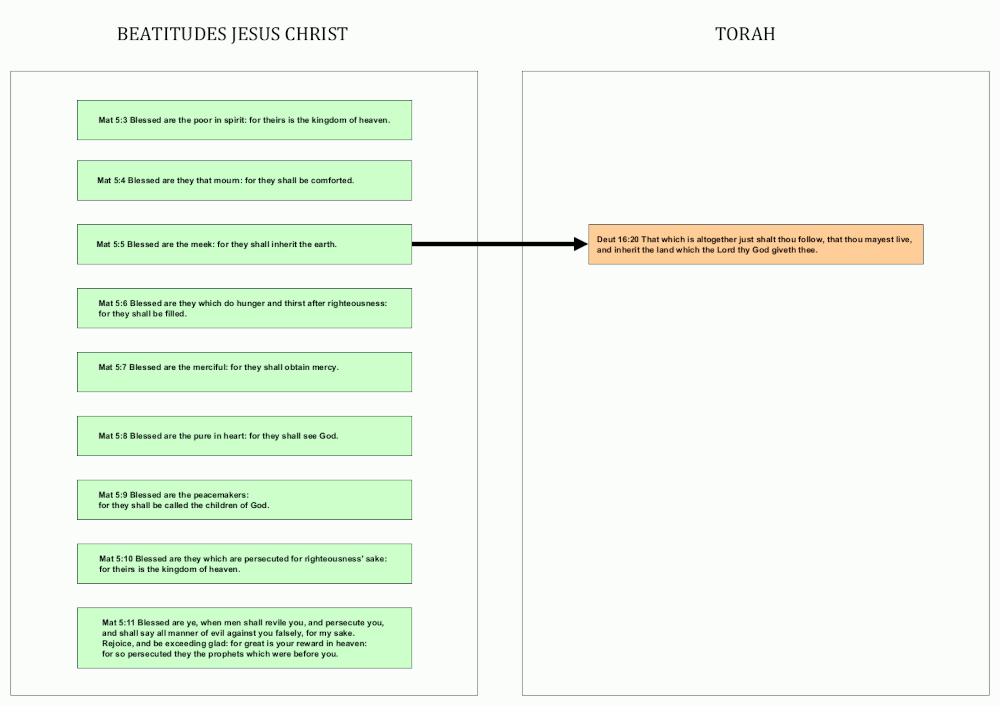
A concept is an abstract or generic idea that has been generalized from certain instances. It is possible to consider the Beatitudes of Jesus (Matthew 5:3-11) as such a concept.
Matthew 5:3 - Blessed are the poor in spirit: for theirs is the kingdom of heaven. Coming Kingdom of God is absent in the Torah. Matthew 5:4 - Blessed are they that mourn: for they shall be comforted. Absent in the Torah. Matthew 5:5 - Blessed are the meek: for they shall inherit the earth. Deuteronomy 16:20 - That which is altogether just shalt thou follow, that thou mayest live, and inherit the land which the Lord thy God giveth thee. Matthew 5:6 - Blessed are they which do hunger and thirst after righteousness: for they shall be filled. Absent in the Torah. Matthew 5:7 - Blessed are the merciful: for they shall obtain mercy. Absent in the Torah. Matthew 5:8 - Blessed are the pure in heart: for they shall see God. Absent in the Torah. Matthew 5:9 - Blessed are the peacemakers: for they shall be called the children of God. Absent in the Torah. Matthew 5:10 - Blessed are they which are persecuted for righteousness' sake: for theirs is the kingdom of heaven. Absent in the Torah. Matthew 5:11 - Blessed are ye, when men shall revile you, and persecute you, and shall say all manner of evil against you falsely, for my sake. Absent in the Torah.
The Lord’s Prayer
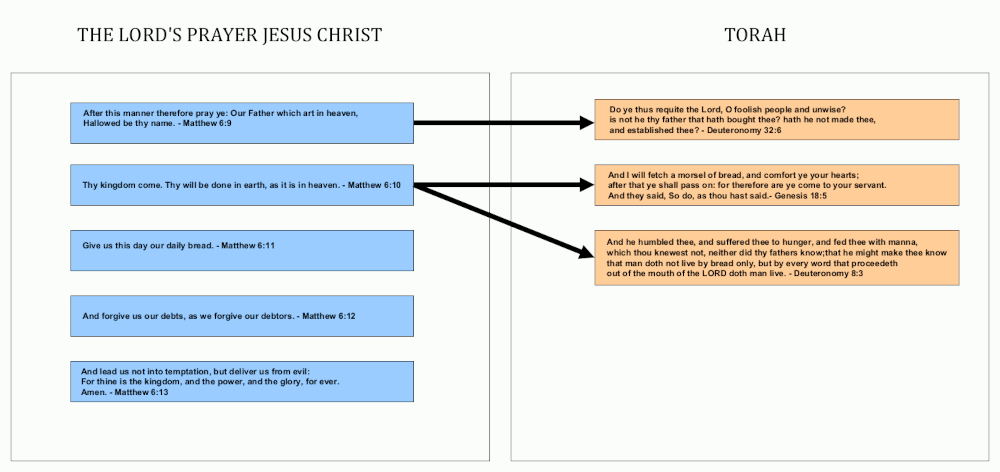
Matthew 6:9 - After this manner therefore pray ye: Our Father which art in heaven, Hallowed be thy name.
Deuteronomy 32:6 - Do ye thus requite the Lord, O foolish people and unwise? is not he thy father that hath bought thee? hath he not made thee, and established thee? Matthew 6:10 - Thy kingdom come. Thy will be done in earth, as it is in heaven. Coming Kingdom of God is absent in the Torah. Matthew 6:11 - Give us this day our daily bread. Genesis 18:5 - And I will fetch a morsel of bread, and comfort ye your hearts; after that ye shall pass on: for therefore are ye come to your servant. And they said, So do, as thou hast said. Deuteronomy 8:3 - And he humbled thee, and suffered thee to hunger, and fed thee with manna, which thou knewest not, neither did thy fathers know; that he might make thee know that man doth not live by bread only, but by every word that proceedeth out of the mouth of the LORD doth man live. Matthew 6:12 - And forgive us our debts, as we forgive our debtors. No reference in Torah. Matthew 6:13 - And lead us not into temptation, but deliver us from evil: For thine is the kingdom, and the power, and the glory, for ever. Amen. Coming Kingdom of God is absent in the Torah.
“I am” statements
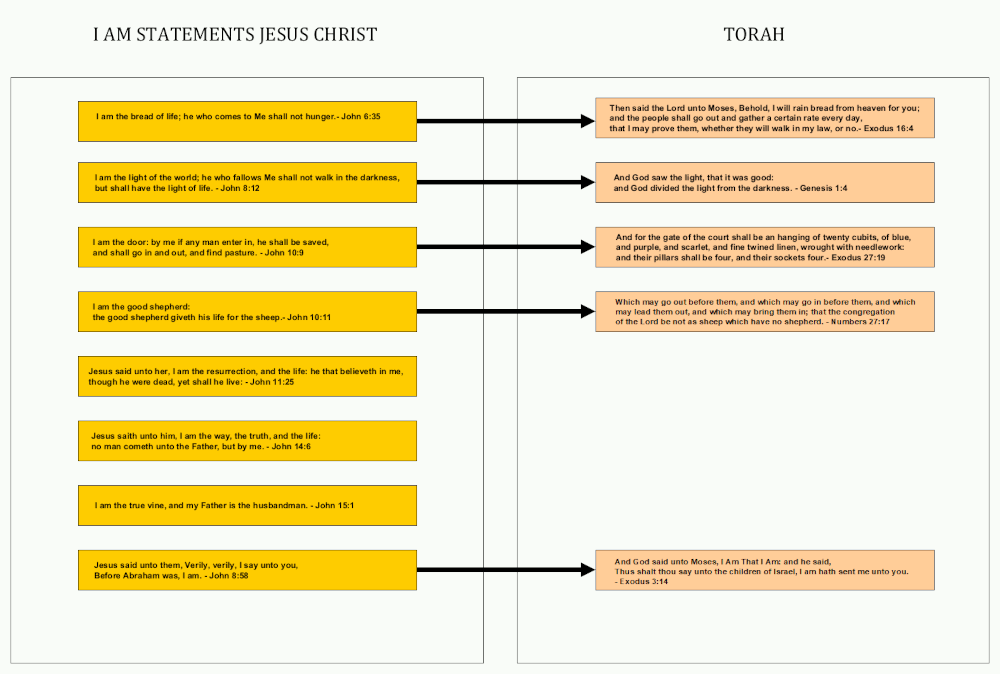
God’s name expresses who he is. He is the I am, which means, the eternal, perfect one and above and beyond all. Jesus claims that he is the “I am”:
1. I am the gate
2. I am the light of the world
3. I am the bread of life
4. I am the good shepherd
5. I am the resurrection, and the life
John 11:25 - Jesus said unto her, I am the resurrection, and the life: he that believeth in me, though he were dead, yet shall he live:6. I am the way, the truth, and the life
John 14:6 - Jesus saith unto him, I am the way, the truth, and the life: no man cometh unto the Father, but by me.7. I am the true vine
John 15:1 - I am the true vine, and my Father is the husbandman.8. Before Abraham was, I am
Guidelines for holines
Matthew 5:48
“Be ye therefore perfect, even as your Father which is in heaven is perfect.” (Matthew 5:48). This guideline strongly echoes Leviticus 19:2: ‘Be holy because I, the Lord your God, am holy’ and Deuteronomy 18:13: “Thou shalt be perfect with the Lord thy God.”Sacrifice of the Son of God
“For God so loved the world, that he gave his only begotten Son, that whosoever believeth in him should not perish, but have everlasting life.” (John 3:16) and “The next day John seeth Jesus coming unto him, and saith, Behold the Lamb of God, which taketh away the sin of the world.” (John 1:29). Both verses can be related to the sacrifice of the son of Abraham in Genesis 22. The son of Abraham was to die, but God gave Abraham a ram as a substitute sacrifice. That made it possible for the son of Abraham not to die. In the same way, God has a sacrifice for sins, the Lamb of God, Jesus Christ, who died as a substitutionary sacrifice to bear the punishment of a man.
Objections of Judaism
Some scholars sympathetic to Judaism claim that all of Jesus' teachings contain references to the Hebrew Scriptures. However, they refer to the Nevi'im (Prophets) and Ketuvim (Writings) outside the Torah. The most quoted verses come from the books of Isaiah, Psalms and Proverbs. Note that all teachings in the books of prophets and scriptures can be derived from the Torah, therefore they have a lower place in Judaism. Mainstream Jews believe that only the Torah is the full text of the covenant of the people of Israel with God and contains all of God's commandments to the people of Israel. On the Jewish side, the objection is that: “a Jesus who is not recognizable to His own Jewish people as the Messiah of Israel.” [5]. They try to show that Jesus followed and taught the Law, with a one-sided view of Bible verses that Jesus promoted the Torah. They do not list the full list of Bible verses in which Jesus deviated from Torah practices in his day. These are the underlying topics:
Jesus is greater than the Torah
The statement “But I say unto you, That in this place is one greater than the temple” (Matthew 12:6) means that Jesus is claiming that he is greater than the temple. After the resurrection of Jesus and the destruction of the Temple of Jerusalem, the Jews had replaced Temple-based worship with Torah conservation and interpretation. [7][8] Then the Torah or Law became the spiritual core of Judaism. That means, according to Matthew 12:6, something much better than the Torah is available with Jesus Christ [9]. Followers of Jesus have the directive not to follow the aggressor by returning evil for evil. [10]
Conclusion
The references to the Torah in Jesus' preaching were not just for the people of Israel, but for all of humanity. The law of Moses has been used by Jesus as a framework to promote a more productive living faith. Jesus showed this with supernatural results. However, the limited references to the Torah in Jesus' preaching show a period in God's relationship with his people. A new way of a direct personal relationship with God through Jesus has arrived. The Temple of Jerusalem no longer plays a role. Jesus is the teacher of a deeper spiritual level than the Torah can offer. His sacrifice downplays the temple. The followers of Jesus are the light of the world.
Notes
- Bracha Yaniv, Torah, in: Encyclopaedia Judaica, Second Edition, Volume 20, To-Wei, MacMillan, Detroit, 2007, 39.
- Hans Küng, Islam, Past, Present & Future, Oneworld, Oxford, 2009, 497.
- Daniel Patte, The Gospel according to Matthew, A Structural Commentary on Matthew's Faith, Fortress Press, Philadelphia, 1987, 77.
- Walter Grundmann, Das Evangelium nach Matthäus, Theologischer Handkommentar zum Neuen Testament, Evangelische Verlaganstalt Berlin, Berlin, 1968, 135.
- Jewish Voice, Jesus Taught Against the Law of Moses, Jewishvoice.Org.
- Toby Janickiy, The Man to Whom Messiah Revealed His Name, First Fruits Of Zion, 2017, Ffoz.Org.
- Jacob Neusner, ‘The formation of Rabbinic Judaism: Yavneh form 70-100’, in H. Temporini & W. Haase (eds.), Aufstieg und Niedergang der Römischen Welt: Geschichte und Kultur Roms im Spiegel der Neueren Forshung, Berlin, Neusner 1979, 42.
- A. Van Aarde, ‘”On earth as is in heaven” – Matthew’s eschatology as the Kingdom of Heavens that has come’, in J.G. van der Watt (ed.), Eschatology of the New Testament and some related documents, Mohr Siebeck, Tübingen, 2011, 46.
- R.T. France, ‘Matthew and Jerusalem’, in D.M. Gurtner & J. Nolland (eds.), Built upon the rock: Studies in the Gospel of Matthew, Eerdmans, Grand Rapids, 2008, 207.
- Donald A. Hagner, Word Biblical Commentary, Volume 33A, Matthew 1-13, Word, Dallas, 1993, 132.


